True Friendship

Friendships are vital to the life of the Body of Christ. They warm the heart, rejoice in victories, and give empathy, understanding and support in trials. Friends are great to chat with and to have fun with but my best friend must be God and after that my husband. Nurturing the children comes next. These are the priority relationships that the Lord has given us, and these are the ones that we will have with us all of our lives. After God, husbands, and family comes the church. We are to extend hospitality to other believers, edifying each other. If our friendships are taking away from those priorities, then we have adjustments to make. Don’t let other people take precedence over your husband and children.
~Kim Brenneman, Large Family Logistics, pg91~

P1200859

True friendship is a sacred, important thing, and it happens when we drop down into that deeper level of who we are, when we cross over into the broken, fragile parts of ourselves. We have to give something up in order to get friendship like that. We have to give up our need to be perceived as perfect. We have to give up our ability to control what people think of us. We have to overcome the fear that when they see the depths of who we are, they’ll leave. But what we give up is nothing in comparison to what this kind of friendship gives to us.
~Shauna Niequist, Cold Tangerines, p50~

 P1200860

Friendship is about risk. Love is about risk. If we can control it and manage it and manufacture it, then it’s something else, but if it’s really love, really friendship, it’s a little scary around the edges.
~Shauna Niequist, Cold Tangerines, p50~

Hosanna in the Highest!

All glory, laud, and honor to Thee, Redeemer, King!
to whom the lips of children made sweet hosannas ring.
Thou art the King of Israel, Thou David’s royal Son,
Who in the Lord’ name comest, the King and Blessed One.

All glory, laud, and honor to Thee, Redeemer, King!
to whom the lips of children made sweet hosannas ring.
The company of angels is praising Thee on high;
and we with all creation in chorus make reply.

All glory, laud, and honor to Thee, Redeemer, King!
to whom the lips of children made sweet hosannas ring.
The people of the Hebrews with palms before Thee went;
our praise and prayers and anthems before Thee we present.

All glory, laud, and honor to Thee, Redeemer, King!
to whom the lips of children made sweet hosannas ring.
To Thee before Thy passion they sang their hymns of praise;
to Thee, now high exalted, our melody we raise.

All glory, laud, and honor to Thee, Redeemer, King!
to whom the lips of children made sweet hosannas ring.
Thou didst accept their praises, accept the praise we bring;
who in all good delightest, Thou good and gracious King.

Ride on, ride on in majesty! Hear all the tribes hosanna cry;
O Savior meek, pursue Your road with palms and scattered garments strowed.

Ride on, ride on in majesty! In lowly pomp ride on to die.
O Christ, Your triumphs now begin o’er captive death and conquered sin.

Ride on, ride on in majesty! The host of angels in the sky
look down with sad and wondering eyes to see the approaching sacrifice.

Ride on, ride on in majesty! Your last and fiercest strife is night.
The Father on His sapphire throne awaits His own anointed Son.

Ride on, ride on in majesty! In lowly pomp ride on to die,
bow down your meek head to mortal pain, then take, O Christ, Your power and reign.

Yesterday in worship, I got to say my son’s name a lot. Hosanna. His name means save Lord and is a cry to the only One who can save to the uttermost. The service began with the choir, pastors, and dozens upon dozens of children processing through the sanctuary with palms in their hands while we all sang to the Lord of His glory and honor, lauding Him with our praise. We cried out to Him beseeching Him to save us! And since we are on the other side of the story, we know with confidence that He is the Savior! He has saved us! He did triumphantly bear our sins and conquer death, saving us from the holds of those shackles! Amen!

But we are still in the midst of the story.

I sat there with my family, in the midst still of our own story of asking the Lord to save and preserve and give us life in place of death…
In front of us was a family whose daughter suffered a terrible cancer some years ago, and the Lord preserved her precious life, and there she sat with parents and siblings, with health glowing in her cheeks and hair and the saving presence of the Lord spilling from her eyes as she sang…
In front of them sat a family who buried another son this very week, the Lord saved Gilead by ushering him to heaven, and now He saves this family every moment by upholding them even in the midst of horrible grief…

I cried repeatedly.

Suffering everywhere I looked. Sometimes already redeemed. Sometimes not yet.
It is hard to wait for the redemption, and wonder whether we will see it here in this life, or whether we will be yet waiting to see it in the next.

And then the sermon came. And Pastor Sumpter spoke on hope & joy.
He said, so much of joy is bound up in hope.
How painfully, purely accurate.

Jesus came to restore the places where suffering and despair have reigned.
He came to save.
He came to give us hope.
~Toby Sumpter~

And so as we begin to walk through this week leading up to Easter, where we consciously focus on the work of Christ in His final days, I am also focusing on His current work even now as His Spirit continues to save and give us hope.

Romans 2:1-5
Therefore, since we have been justified by faith, we have peace with God through our Lord Jesus Christ.Through Him we have also obtained access by faith into this grace in which we stand, and we rejoice in hope of the glory of God. Not only that, but we rejoice in our sufferings, knowing that suffering produces endurance, and endurance produces character, and character produces hope, and hope does not put us to shame, because God’s love has been poured into our hearts through the Holy Spirit who has been given to us.For while we were still weak, at the right time Christ died for the ungodly.

This week, I will be reminding myself day by day to be joyful even when I don’t know the end of the story. Because that is why Christ came. I rejoice in hope ~ and this hope is not bound up or settled on the things of this world. This hope in which I rejoice is bound up and settled on the glory of God. And because of this, because of God’s glory, we can rejoice fully! Even when suffering comes. Even when endurance is necessary. When character is tried, tested, affirmed.

This hope is not foolish. Hope that is grounded in God’s glory will not put us to shame. He died for me. So that I could have hope. So that I could rejoice. So that as I remind myself of these things this week, walking toward Easter, I will remember the joy and the hope along with the suffering and the grief. It’s the dichotomy of living the Christian life. May He give us the strength and peace to glorify Him this week through all of this.

We rejoice in the hope of the glory of God.
~Toby Sumpter~

Blitz Trip Grace

By God’s grace, the Holy Spirit’s fruit of patience and gentleness swell and ripen in these times.
God gets the glory for giving me the strength I need
to be kind to my children when I feel hurried or annoyed at the end of a very long day.
And in times when I let the Spirit’s fruit rot because of my sinfulness,
the Lord gives me the grace I need to apologize to my kids
for my hastiness, insensitivity, and unkind words.
Bedtime is a maturing experience for all of us.
~Gloria Furman, Treasuring Christ When Your Hands are Full, p111~

Other maturing experiences might be long drives in the car and blitz weekend trips that are so packed with fun busyness that naps & bedtimes kind of go by the wayside… So on mornings like today, I am extra thankful for grace, and am asking Him for extra measures of kindness, patience, gentleness, and joy today as we readjust to being home and as we reach for good things like naps & bedtime.

But man, aren’t weekend blitz trips with long car rides and occasions for grace just marvelous for the family!? Love it.

P1200840  P1200845

The Lord’s People on His Day

This morning we have the joy and privilege of worshiping at Trinity Reformed Church, where a longtime dear friend of my family is pastor. It is the liturgical church that has continued to deepen our love of and desire for beautiful old church liturgy. While we were looking for a new church home a year+ ago, we were able to visit Trinity Reformed Church a little more regularly (it’s a 2 1/2 hour drive each way, so not exactly a place we could call our own church home unless we moved), but we have been settled at Christ The King Church now (and it’s only 50 minutes away, so very reasonable for being our church home) for so long that we have not visited our friends at Trinity since July! Until today. What a joy and blessing. The Lord is good.

And just because these two blog snippets from Pastor Sumpter were so liturgically pertinent, I have to share them.

You have not been summonsed here to make a respectable appearance in a religious assembly. You have not been summonsed here to go through the motions of some ritual. You have not been summonsed here to mechanically repeat your lessons. You have not been summonsed here to compete with others, to gossip, to envy, or to worry. You have been summonsed here this morning to worship. You have been summonsed here to make a joyful noise to the Lord. You have been summonsed here to serve the Lord with gladness, so sing to Him with all your heart and mind and soul. You have been summonsed here so that you might remember and know that the Lord Jesus, He is God. He made us: we are His sheep. You have been summonsed here to thank Him, to bless Him because He is good.

and

…in Ephesians, [Paul] says that our inheritance is in Him, and in Him we have forgiveness, and in Him we have the Holy Spirit, and in Him God is uniting all things. In other words, we can’t move or think or breathe or eat or drink apart from Him. Our identities are completely bound up in Him. This is what it means to be a Christian: that we no longer live for ourselves but now we live for Him because we live in Him. But this means that all of our human interaction is also in Him. We talk together in Him, we walk together in Him, we eat together in Him, we work together in Him. This is why Christian friendship, Christian marriage, Christian family, Christian business, Christian community is all about sharing Christ in and through the various activities we engage in. And this is not just a way of speaking; we are confessing fundamentally that God is here with us. God is present in us and around us. He is here.

So, on this Lord’s Day, worship the Lord because He is good, and may the Lord be with you all. Amen.

Sharp Regard

P1200814

At the root of many a woman’s failure to become a great cook
lies her failure to develop of a workmanlike regard for knives.
~Robert Farrar Capon, The Supper of the Lamb: a Culinary Reflection, p56~

 P1200819  P1200823

Properly edged and skillfully used,
a cleaver will prepare whole meals without the assistance of another knife.
But it does more.
It bolsters your ego as a cook.
Parting chickens with aplomb, you begin to believe you really might make it.
And so does everyone else.
A woman with cleaver in mid-swing is no mere woman.
She breaks upon the eye of the beholder as an epiphany of power,
as mistress of a house in which only trifles may be trifled with—
and in which she defines the trifles.
A man who has seen women only as gentle arrangers of flowers
has not seen all that women have to offer.
Unsuspected majesties await him.
~Robert Farrar Capon, The Supper of the Lamb: a Culinary Reflection, p61~

 P1200826  P1200827

Blessed is the woman whose husband surreptitiously touches up her knives
It may cost her a few surprise cuts now and then, but they are a small price for perfection.
Thrice blessed, though, is the woman who does the job herself.
~Robert Farrar Capon, The Supper of the Lamb: a Culinary Reflection, p61~

P1200821

running

P1200640

The road to Heaven does not run from the world but through it.
~Robert Farrar Capon, The Supper of the Lamb: a Culinary Reflection, p180~

P1200639

I engaged with them in the moment.
They were never meant to be permanent.
~N.D. Wilson, Death by Living, p101~

P1200627

Sipping Light

This is a praiseful realization:
love is bit and bridle, despair, the beast.
To live well is to learn how to ride,
how to lean into grief.

That is how one of the opening pages in A Small Cup of Light first introduces you to the author, Ben Palpant, as he opens a window into his life for you to peer into some of the work the Lord has done. Speaking of his wife early in the book, he says, “she set aside her fears to speak into my own” (p25), and that is what A Small Cup of Light is all about—setting aside personal fear to step into pain with someone else—bearing burdens together as one way to share the light of Christ.

God. Help. Me.
Nothing but me and my need stated frankly and simply. I have since wondered if, perhaps, this prayer is the most elemental of all prayers. Perhaps this is the most indispensable form of any petition. (p93) Now I know that God is always present. I’ve known that since I was a little boy. But I do not think we feel His presence very often. I certainly had not until that moment. (p95)

My family has the sweet privilege of personally knowing the author, of having worshipped alongside his family for nearly a decade, and while we knew he was suffering in some ways, we had very little information about it at the time, mostly just knowing that he was in a place of pain & vulnerability—and it made him one of the most empathetic people we bumped into on a weekly basis. One of the most personal ways Mr. Palpant has blessed my family is through prayer. Through the years—particularly during six of my recurrent miscarriages—he has encouraged us to pray along with him, in church and in less official places—and I have long thought that his prayers have even helped shape my Gabriel’s prayer life specifically when he was a toddler—the most stunning example being a prayer vigil that Mr. Palpant organized in our front yard when I had just delivered our tiny son Hosanna back in 2010.

She had invited herself into my suffering so she could empathize with me, walk with me, and speak to God on my behalf. (p99) Many such moments, unexpected cups of light, made my heart weep for joy and glimpse the sun again. Each moment reminded me that my weakness, my perceived failure, was bringing about a new birth not only in me, but in those around me. (p99) I am learning slowly to see life as God sees it. God is giving me new eyes. (p101)
I am an arrow shot from a bow string. I am a bird in flight. I am a falling leaf. (p122)

Though night may again fall upon me suddenly, You, O God, will be my refuge. Though I find myself in a desert, stumbling beneath a starless sky, still, I will listen for the shy song of that small bird, Hope. I will follow it, weeping and singing. So it is and so it will be. Weep and sing. (p126) Despair is not the only viable response to suffering. I offer a different one: celebration. (p126) Suffering is a night, a brooding blank on the soul’s staring eye. Those who have suffered deeply remember the constriction, the immobilizing fear and doubt. A million moments of laughter and pleasure in life may slip from memory, but we recall the pain with ease. (p129) Joy sometimes saddles despair’s back. (p129)

After having only occasionally run into him over the last year—one time being able to snatch his autograph on our copy of A Small Cup Of Light—we were overjoyed when we found out that Mr. Palpant was going to be coming to our church for weekly Lenten lectures this year between Ash Wednesday and Holy Week, to share some of the dark corners and deep honesty from his book, from his life, from how the Lord has brought beauty from his suffering.

Most of what he shared at the weekly Wednesday night gatherings are things with which I am (and perhaps you are too) familiar—whether it is the emotional, the physical, or the spiritual side of suffering. He does tell snippets of his personal story, but I think he knows that most of us had already gotten our hands on his book & the majority of us had read through it rather quickly, so he mostly has gone less from him and more to the journey. Rather than telling us again all about his particular story of suffering, and all the paths the Lord prepared for him and how He has carried out this story of life through this one man & his family—he gives us lessons that he has gleaned by God’s grace through his own story, which apply to all thirty or fifty of the other stories gathered in the room where he is speaking.

No child in the history of mankind, when asked what he would like to do when he grows up, has ever responded, “I want to suffer.” (p29) What really terrified me was that divine hands, against which I was simply powerless, had created that fissure into which I felt myself sliding. (p36) …The dilemma that kept barking at the back door of my mind was this: A good God is fine when life is tropically blissful, but what when the hurricane comes? Where is the safe haven then? What are we to do when chaos bangs against the windows and when the roof of reliability is ripped off? What to do with all this suffering? C.S. Lewis called pain God’s megaphone. John Piper has called pain God’s pedagogy. “God, I am listening. Teach me. Speak into this bewilderment.” (p43) Hawk and hen, God made them both. (p47)

We converse with one another—other image bearers of God the Father, Creator of us all—over bowls of soup and fists full of bread. Often, it seems that these are opportunities to get beyond the normally casual conversations between mere acquaintances, allowing us to delve into new corners of companionship, comradery, actual fellowship (which isn’t just talking, but spurring one another on to love and good works, in the spirit of Hebrews 10:24-25). And then someone serves us by donning an apron (and let me tell you, when our pastor dons an apron, and washes the feet of Christ’s disciples by cleaning up after our messes, it serves as a truly wonderful embodiment of a shepherd caring for his sheep by humbling himself & laying down his life—when I was personally blessed by that for the very first time a couple weeks ago, it struck me with so much grace and joy) to clean up the messes we have made, and we shuffle our chairs until we can look at Ben Palpant, and all listen with our ears & our hearts—because every single one of us suffers. We have different stories: we are an entire library of biographies gathered in one room, each story being unique and enthralling in its own way, with its own climaxes and culminations. But we have common threads. And the Lord’s working in our lives takes the shape of suffering at various points and in various ways—but none of us is spared from it. Oh! Lest we grow haughty or callous, none of us can escape the hand of the Lord. If you haven’t felt it yet, you will yet someday. Some way.

Humor became a kind of relief valve in our home, momentarily warding off mountain fears. Tenderness coupled with laughter became a balm even to me. (p79) I thought of the fatigue that came from trying to live and the fear that came from not trying. (p85) How easily we forget how much mental strength is required to argue, to complain, to kick against God. (p91) Suffering is personal. Although a community, a family, an entire people group might face the same loss, each member must taste the wormwood on his own tongue. The bitterness is individualized, tailored for each of us. A mystery. (p92)

And so with one common storyline being emphasized, that of suffering, we listen to Mr. Palpant offer encouragement, exhortation, observation, challenge, comfort, grace. And it is a time of souls and stories mixing together, hearts softening, sometimes theologies bumping into one another. It has been a time of great conversation starters too—questions about God’s ordaining, allowing, creating (or lack thereof) of suffering, devastation, catastrophe, calamity, even evil. I have had really great conversations about these things over the last couple of weeks with my husband, a few people from church, a friend online, and my sister-in-law.

God does not look at our suffering from afar. It is an intimate event to Him. (p48) [Jesus] is after much more than happiness in our lives. He is after a sustaining joy and He will give us that joy by giving us Himself, whether through the small gifts of life that bring us gladness or through the dark night of suffering. Sweeping affliction under the rug of our heart, therefore, is simple denial, an act of cowardice, and an act of ungratefulness. We must dare to look it square in the eyes. (p50) If we try to comfort ourselves in our need instead of leaning fully on our God and Savior, God promises to make us taste that need full force. (p78)

Ruth’s mother-in-law Naomi, in Scripture, plainly believed that the Lord Himself brought the calamity of multiple bereavements upon her (Ruth 1:20-21). Isaiah, inspired from the mouth of the Lord to speak on His behalf, proclaimed that there is no god but Yahweh, and that He forms light and creates darkness, makes well-being and creates calamity—it is the Lord alone who does all these things (Isaiah 45:5-7). In some translations, verse 7 even says “I make peace and create evil”—try that on for size for a conversation starter in a Christian church setting. 🙂 Pair it with Amos 3:6 which says,

Is a trumpet blown in a city,
and the people are not afraid?
Does disaster come to a city,
unless the Lord has done it?

Clearly the Lord does all these things, even calamity and disaster… yet Christians are pretty diverse, I’ve noticed, on the interpretation of the Lord’s involvement here. As though we are not to take Scripture for what it plainly says! But following that up with reading Psalm 135:5-7 (and the examples that follow, through verse 13) is pretty great:

For I know that the Lord is great,
and that our Lord is above all gods.
Whatever the Lord pleases, He does,
in heaven and on earth,
in the seas and all deeps.
He it is who makes the clouds rise at the end of the earth,
who makes lightnings for the rain
and brings forth the wind from His storehouses.

Mr. Palpant reminds us that, to put it bluntly, we are not the center of the universe—our entire point of life is to glorify God. Like Isaiah 48:10-11 says,

Behold, I have refined you, but not as silver;
I have tried you in the furnace of affliction.
For My own sake, for My own sake, I do it,
for how should My name be profaned?
My glory I will not give to another.

So for the last five weeks, we have been weekly blessed to share fellowship with people on a level that has been intimate—discussing the vulnerable, sacred places of our lives that are, well, terrible. And it has been good to enter into the terrible things with one another, to get past the shallow and the superficial, to encourage one another to see Christ in the darkness and sip His light!

How long must I learn to carry this grief in faith? How lasting is suffering’s effect on the soul? Heaven promises to be a place without grief, without tears. Does that mean that I forget my story in Heaven? I don’t think so. (p134) I have a hunch that we’ll spend eternity remembering our own suffering also, learning how to wear it well, remembering that Christ’s suffering redeemed our own, and realizing how our trials worked to glorify God, the great Story-Teller. All our singing will be prompted not by forgetfulness, but by thankfulness. (p134) Suffering in every form is meaningless and hopeless unless God is in control of it. (p148)

This book is good drinking, er um, reading. Steven read the whole thing one long, restful Sunday afternoon. I read it in snippets over numerous evenings, because I could only swallow so much at a time. But take a sip, a gulp, drink it up—you won’t be sorry you savored it, because in the drinking, You will taste the sweetness that comes from bitterness shared, and the blessings that God intends for us even as He glorifies Himself in the darkness when we see His light.

 As though I made it to the other side of the trial and can now move on. At some deep place inside, we’d like to simply get through our suffering and move on, but this does not accurately picture reality. (p130) It is a mistake to think that I can just get through my trials. We are the accumulation of our experiences and we do ourselves a disservice if we embrace only the happy parts of our story. The dark moments of our existence are also worth valuing because they are an essential part of the story that a good God is telling. They are not an accident of existence. (p131)

Anticipating death and calling it gain, Christians are evangelists of the grotesque. The very hope of the Gospel rests directly upon our ability to imagine a world in which suffering serves as the soil from which resurrection springs. (p133) I think another lesson I learned is that life is not so much about what I’m doing for God as much as it is about how I’m learning to see what God is up to in my life. I try too hard to please God by my efforts instead of letting my efforts spring naturally from a kind of thankfulness for what He has done is doing in my life. Perhaps the hardest prayer I’ve learned to pray is this one: “Lord, I’m ready for You to do whatever You must to draw me close to You.” It’s a terrifying prayer for some reason, but it’s also very liberating to vocalize. (p150)
Homeschooling Grace

Yes, give them God’s law.
Teach it to them and tell them that God commands obedience.
But before you are done, give them grace and explain again
the beautiful story of Christ’s perfect keeping of it for them.
~Elyse Fitzpatrick & Jessica Thompson, Give Them Grace, p36~

 P1200747

Everything that isn’t gospel is law.
Let us say it again: everything that isn’t gospel is law.
Every way we try to make our kids good that isn’t rooted
in the good news of the life, death, resurrection, and ascension of Jesus Christ
is damnable, crushing, despair-breeding, Pharisee-producing law.
~Elyse Fitzpatrick & Jessica Thompson, Give Them Grace, p36~

As I continue on the somewhat daunting, but ever rewarding, task of homeschooling my children by God’s grace, I seek to do it not only by God’s grace, but for God’s grace. I just ordered curriculum for the next year or so of Gabriel’s official education, and once again I am so easily drawn into the law side of things. But that’s not the beauty of the gospel! The beauty, the gift, of the gospel is the utter and complete GRACE of it. Grace for each subject. Grace for methods. Grace even for principles. Grace for me. Grace for my children. Grace upon grace upon grace!

P1200748

Oh! What a mercy and a joy and a privilege and an honor.

Thanks be to God. I would not want any other job than that of being the one to train and educate and mold and fill these little people. May God grant me the grace and diligence I need to do it well for His glory.

P1200752

Goodness Rising & Multiplying

Food is the daily sacrament of unnecessary goodness,
ordained for a continual remembrance that
the world will always be more delicious than it is useful.
Necessity is the mother only of clichés.
It takes playfulness to make poetry.

~Robert Farrar Capon, The Supper of the Lamb: a Culinary Reflection, p40~

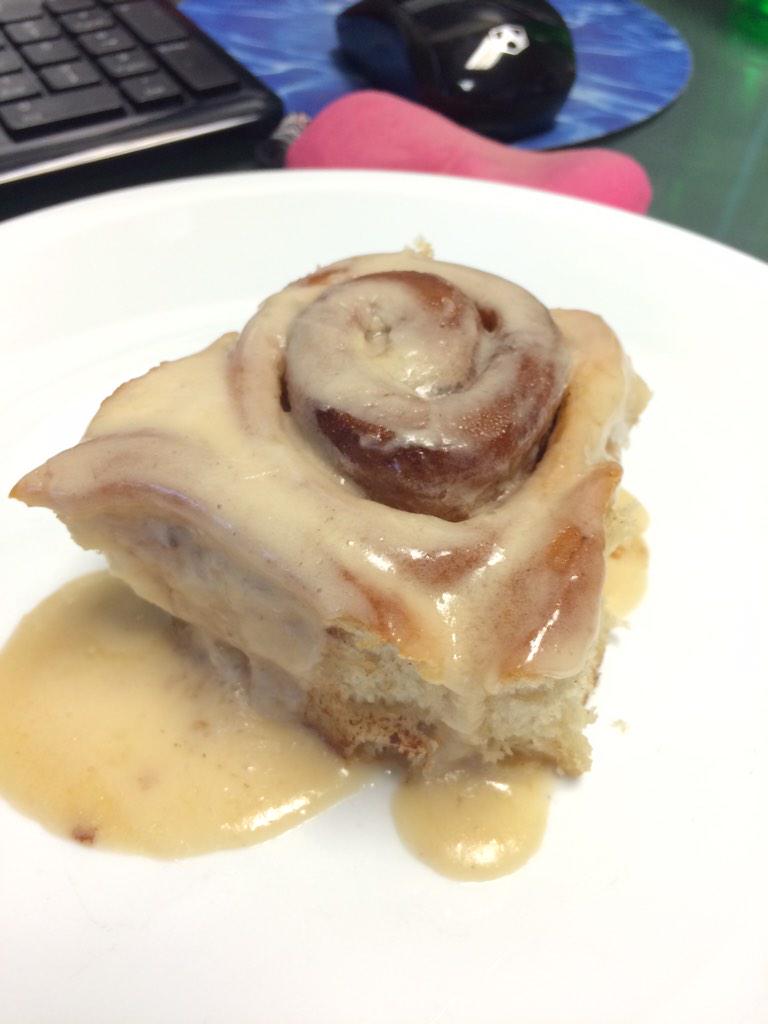
Embedded image permalink


Courtesy of one of my hubby’s coworkers a couple weeks ago, that’s a little peek at some of the yummy goodness that I sent to Steven’s office to cheer the hard laborers there. I like to send goodies every so often (I would like to do it at least monthly, but my brain & my follow-through is not always up to par with my desire!) But I am kind of well known there for my cinnamon rolls. A few years ago, I tried this recipe and now I just have my own sort of recipe (guidelines, really…) in my head, and I just make them from my own memory, and with my own intuition, using my own five senses. And honestly, while I did not grow up liking cinnamon rolls all that well (even though my mother totally rocks at them!!), I do miss these cinnamon rolls on my low-sugar, gluten-free diet. It is the sugar, the gluten, and the way the yeast rises in glorious goodness that makes these the cinnamony delights that they are.

Don’t go easy on the butter, don’t forget to use a heavy hand with sugar and cinnamon, and don’t mess with the flour ~ gluten free or freshly ground whole wheat, for instance? Umm NOPE. Don’t even bother. Don’t waste your time. If you aren’t going to indulge in the best cinnamon rolls in the world, then don’t even try to ease in around the edges. Some things have to be full fat, full sugar, full gluten. And these are definitely a solid case in point.

I had signed up to bring coffee hour snacks following yesterday morning’s worship service. It’s funny how different groups of folks can be. (Yes, little rabbit trail: oblige me, please.) At our old church, it was practically like pulling teeth & twisting people’s arms to bring enough food for stuff, or to bring generous quantity to supply all the grumbly bellies & grabby hands. At our new church? People might not necessarily sign up in advance, but they show up with abandon! There are always leftovers. There is always enough for seconds, thirds, and sending leftovers home with people who might need extra food in their hands later. The way these folks bring to life real examples of loaves & fishes multiplying in real tangible ways, with joy and humility and thankfulness… cups overflowing… brings tears to my eyes. It is life-giving.

So as far as I knew, I was the only one who had signed up to bring food for the coffee hour yesterday, and I wanted to be a blessing. My mother has long blessed people with food, and that is one way I delight in following closely in her footsteps. (Someone needs a meal? We’re having a potluck? People are coming over? I’m there!) I was raised in that you always bring twice as much food as you think you might need, because there is no blessing like the blessing of superabundant delicious food. So I made six dozen cinnamon rolls on Saturday. (That’s a double batch, in my book, in case you’re wondering.) I bought two big bags of gala apples to slice, and six pounds of easy-peel mandarin oranges. I put together a plate of sliced cheese with spirals of crackers. I had a package of rice crackers and a small gluten free coffee cake, to boot, because I am not the only one at our church who needs to eat gluten free out of necessity (you know, rather than fad).

Even just what I brought could have fed one hundred people, easily. But then other people showed up, arms full of edible blessings. Someone brought two dozen more freshly baked cinnamon rolls! Someone brought a few dozen Easter cookies fresh from a bakery, just the way the kids dream of. There were donuts and pastries that someone dropped off. And all of a sudden, coffee hour became a festive party. Afterward, we were able to package some things up for the freezer so that in other weeks we will once again have lots of goodies at church over which to have conversations about everything from the weather to Bible studies to childrearing to book collecting. And a few people went home with bags of leftover apples and oranges, handfuls of cookies, and cinnamon rolls to stash away for an afternoon snack. I’m pretty sure nobody needed to go eat lunch after that.

I was thinking back, upon looking at all that multiplication of food, how it just showed up naturally without anyone twisting arms or begging for people to provide it, and what a metaphor of God’s grace and miraculous handiwork it is. He may have provided it through fairly predictable, human means… but He still provided it, and He still showed His grace & handiwork through it. It reminds us of other times when His provision was not predictable, and when His handiwork was miraculous & physically inexplicable rather than common or ordinary.

Mark 6:41-43
And taking the five loaves and the two fish,
[Jesus] looked up to heaven and said a blessing
and broke the loaves and gave them to the disciples to set before the people.
And He divided the two fish among them all.
And they all ate and were satisfied.
And they took up twelve baskets full of broken pieces and of the fish.

As I look back on the baking of my cinnamon rolls, which was a very ordinary way God worked to provide food for people ~ through a woman’s hands working common ingredients together in a formulaic manner ~ I can also see another metaphor of God’s goodness and work. I think of the beauty and the wonder of leavening. Of little tiny yeasts (which are single-celled fungi, isn’t that delightful? read more here) that grow and produce bubbles, by eating sugar and producing carbon dioxide, and cause many wonderful changes in the lump they use for life. Scripture talks a lot about bad leaven (the leaven of the Pharisees, for instance), but Jesus also taught us about good leaven (in the parable of Matthew 13).

Matthew 13:33
“The kingdom of heaven is like leaven
that a woman took and hid in three measures of flour,
till it was all leavened.”

P1200772  P1200773

Watching my dough double and rise until it flopped over the edge of the bowls in the warming oven… rolling it out, smothering it with buttery & sugary & spicy goodness, rolling it again & slicing it up into pretty little round pinwheels… then watching it puff and rise again… oh! It is such an encouraging thing, and reminds me so much of God’s good works. In the dark, in the moist places, when the dough has been pounded and kneaded hard, and left for a while to rest and be on its own… amazing things happen not because I can follow recipes and not because I did things right, but because God is gracious. And even when God in His terrifying holiness seems so categorically unpredictable, He is yet predictable!! He is always gracious, always good, always benevolent and magnanimous! And those of you who know me, know that I don’t say that through rosy colored glasses or eyes of ignorant bliss. I have felt the terrible hand of the Lord. I have been pounded hard, kneaded long, and left in dark places. But this is precisely where so much beautiful rising and multiplying happens. Because the Lord is gracious, He continues to further His kingdom in me, through me, and even in spite of myself.

P1200778  P1200781

What mercy!

A man’s daily meal ought to be
an exultation over the smack of desirability
which lies at the roots of creation.
To break real bread is to break the loveless hold of hell upon the world,
and, by just that much, to set the secular free.

~Robert Farrar Capon, The Supper of the Lamb: a Culinary Reflection, p115~

P1200785

So next time you too put together water, milk, fat, honey, salt, flour, and yeast ~ when you smother it with the fatness of creamy butter and the deliciousness of sweet sugar and pungent cinnamon ~ think about the work God accomplishes even in you. I imagine that you, like me, can see how we fit into the description of even a humble cinnamon roll meant to be ripped apart and enjoyed and shared and prayed over and devoured. I am mixed, kneaded, pounded, left, punched down, smothered in goodness, rolled tightly, sliced into pieces, left again, and heated by an uncontrollable fire, and at last slathered with a thick layer of even more fatty sugary goodness simply because God likes to pour grace on top of grace… and why? Because it blesses my King, gives delight to my Creator, and feeds others around me.

Because God is glorious.

Because sometimes He works through ordinary, common, daily means.

Because sometimes He wants us to smile, and simply see Him in things like rising dough and multiplying food.

Because this is where the Gospel meets the edible.

P1200787

And it’s good.

P1200777